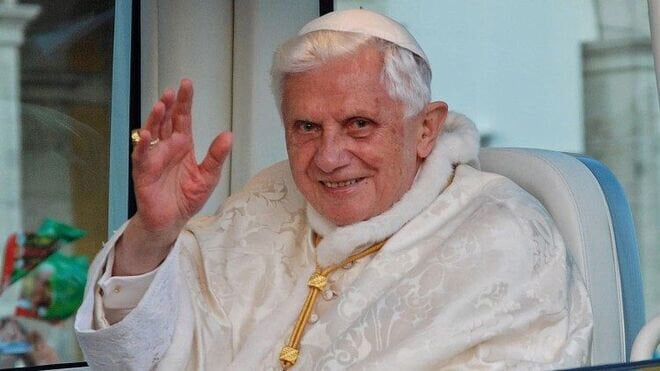

The Catholic Church and the world look at a historical episode today: the resignation of Benedict XVI in 2013. Eleven years later, an unpublished letter has come to light in which Pope Emeritus rejected the theories that questioned the validity of his resignation and explained his decision in clear terms: he did it freely, due to lack of strength and without external pressures.
The letter, dated August 21, 2014 and addressed to the Italian theologian Nicola Bux, has now been published as an appendix of the Book Reality and Utopia of the Church. In it, Joseph Ratzinger describes as “absurd” the speculations that argued that he was still potato or that his resignation had been incomplete. “Dogmatic and canonically, it has always been unquestionable and unquestionable that the Pope can renounce freely, and that his resignation is fully valid,” he writes.
The text also rules out the idea of a progressive schism within the Church for its resignation and remembers that John Paul II came to assess the possibility of retiring, confirming that the Bishop of Rome can, like any other bishop, leave his position.
For more than a decade, conservative sectors and traditionalist groups questioned the legitimacy of Francisco’s pontificate, suggesting that Benedict XVI had been pressed or that he continued to occupy, in some sense, the Petrino Ministry. The letter published today ends, at least on paper, to that controversy, confirming from its handwriting that its resignation was voluntary and that Peter’s throne was completely vacant in February 2013.
Revelation has generated a wave of reactions in social networks and international media, where the letter is interpreted as a document of great historical and theological value, capable of closing one of the most persistent debates in the church of the 21st century.