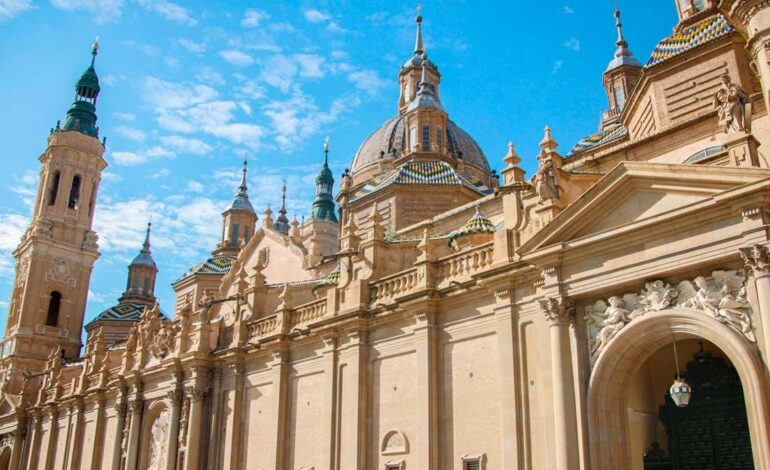

Saragossa It is a city built on other cities. What our feet step on was already a market, temple, wall, ruin, and again home. There are layers under layers, centuries over centuries. And in that deep stratum where history mixes with the rumor, legends, popular stories and voices are born.
Because not everything is documented. There are inexplicable empty, gaps that archeology has not filled, spaces that popular memory have filled with stories. And there appears the other: the possibility, the legend, which cannot be demonstrated but either denying at all.
Zaragoza has history. It has mystery. And sometimes, to understand it, you need to stop looking for certainties and start listening to what has always been there, waiting.
Zaragoza’s gob
Room 510 of the Aragon Crown
The Legend of the Pozo de San Lázaro
The day they bombed the pillar
The first Spanish film was shot in Zaragoza
THE ORIGIN OF THE WORD ZARAGOZA
Cesaraugusta, the Roman amphitheater that Jámas was found
Zaragoza’s gob
The city of Zaragoza witnessed one of the most disturbing and media episodes in its history. We talked about the case of Zaragoza, an urban legend that mobilized the police, attracted the international press and baffled scientists, religious and curious equally. Almost a century later, this event continues to awaken fascination.
The mystery began in September 1934, when the residents of the number 2 of Gascón de Gotor street, in the center of Zaragoza, began to hear laughs and strange voices that seemed to come from the walls. The phenomenon intensified on November 15, when the young maid Pascuala Alcocer turned on the cooking stove and a voice shouted: “Because of what you want the most, do not turn on, that you burn me!”
This terrifying phrase unleashed chaos. What seemed like a joke became a paranormal phenomenon without logical explanation, and gave rise to an official investigation, becoming the first paranormal case documented by the police in Spain.
What followed was unusual: architects, police, sound technicians, priests and even mediums passed through the house. Everyone agreed on the same, there was no way to explain where that voice that spoke with those present came from, sometimes in a mocking tone, other times aggressive. Communications were constant and, most disturbing, he responded to stimuli and questions.
The news transcended borders. Diaries such as The Times collected the case of Zaragoza’s Parlante Goblin, pointing out how thousands of people crowded in the streets of the neighborhood to try to hear the mysterious entity. Even some citizens went up to the roof to check if there was a hidden trick.
Today, the case of Zaragoza’s gob Aragon.
Room 510 of the Aragon Crown
The origin of the enigma dates back to July 12, 1979, when a fire devastated the hotel facilities. The fire began in the cafeteria and quickly spread through the building, leaving 83 people killed and more than a hundred injured. The images of people throwing themselves with the windows to escape from smoke turned the country around. Years later, the Supreme Court concluded that the fire was caused with flammable liquids, but the exact circumstances were never completely clarified.
Since the end of the 90s, strange phenomena began to concentrate on the fifth floor, especially in room 510. Hotel and guests have described extreme temperatures for no apparent reason, lights that turn on and off alone, blows on the walls and burning smells that appear suddenly. Telephone calls without interlocutor, doors of doors that are heated to the touch and steps or voices in empty halls have also been reported.
These types of experiences have not been isolated cases. The first ones that reached the ears of the media were lived by an Aviaco hostess, the regional flight airline bought by Iberia in the late 1990s. While trying to fall asleep, he felt something similar to the presence of a person on his person, and also heard noise, as if someone wanted to open the window desperately.
The mystery of room 510 has transcended the hotel environment to settle in the collective imaginary. It appears in books such as the echoes of the tragedy, by Javier Pérez Campos, where the theory that spaces can “absorb” the emotions of the tragedies and later release them as echoes of the past is explored.
The Legend of the Pozo de San Lázaro
Legend has it that this well has no background, that everything that falls and that is even connected to the Mediterranean Sea, with currents that could drag you to Tortosa.
His name comes from the convent of San Lázaro, founded in 1224 next to the Ebro in the Arrabal de Zaragoza. There, terminal and even morbundos de lepros were banished, whose bodies were thrown into the river. The chasm became a symbol of death, and the legend gained strength when a monaguillo child was crucified in 1250 and thrown into the well; His body never appeared.
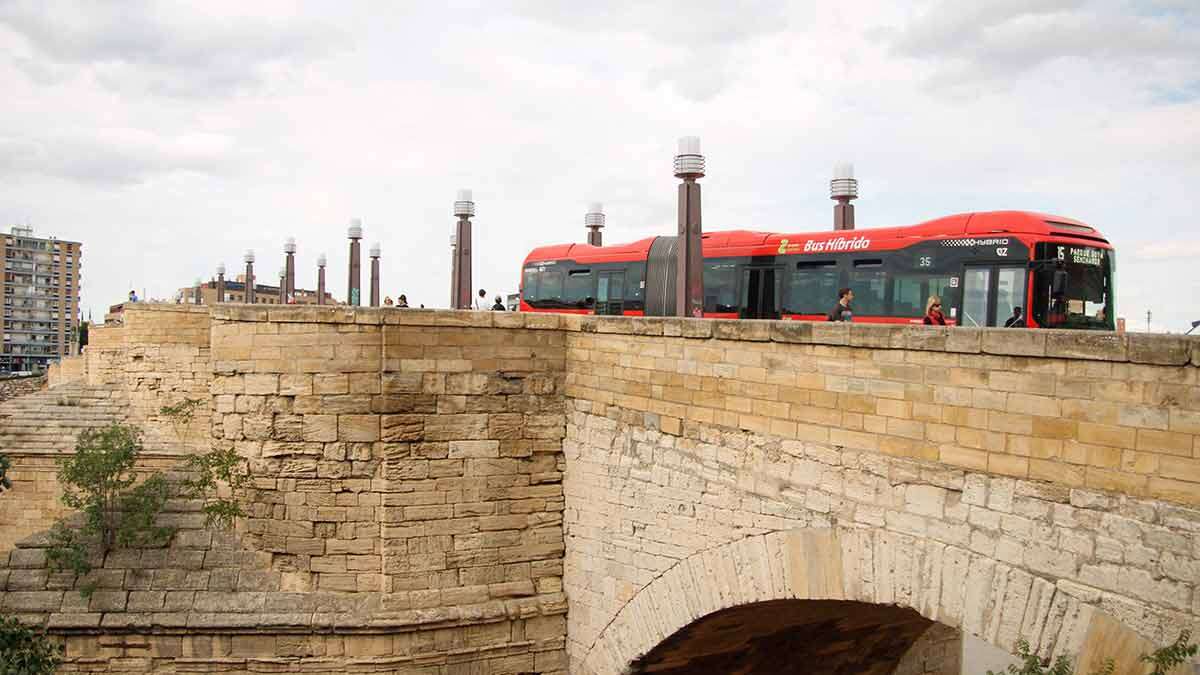
The biggest mystery of the Pozo de San Lázaro arose when a bus that crossed the stone bridge fell into the river and lost in the depths. Photo: Pilar Álvarez
Another story collected by popular voices narrates the tragic destiny of Azucena and Roldán, two young people in love whose families rejected their union. Incredolable, they decided to throw together with a cachirulo (Aragonese handkerchief) to the Ebro, willing to love themselves forever. Their bodies never appeared, and today they are still part of the myth of the well.
The most documented episode occurred in the early hours of December 19, 1971, when a bus that crossed the stone bridge lost control and fell into the well. Of the 52 passengers, ten died, including five children. Nine bodies were never recovered. The attempt to rescue the vehicle failed, sinking more and disappearing forever in the agitated waters of the Ebro River.
The day they bombed the pillar
In the early hours of Monday, August 3, 1936, an XIX Breguet plane from the Prat airfield launched four bombs on the temple of the Pilar de Zaragoza. The pilot was Emilio Villaceballos García, a young republican aviator who acted without official orders.
According to the Zaragoza press of the time, one of the bombs fell in the Ebro, another was embedded in the square in front of the temple portal and two directly impacted on the covers of the Pilar. None of the four explosions occurred, and the damage was minimal, which was interpreted by the rebel side as a miracle of the Virgin. Immediately, the rebel press talked about “divine protection against Marxist barbarism” and built a heroic story around the episode.
Two of the bombs, identified as Hispanic A6 of 50 kg, were rescued by gunners of the teacher and delivered to the Cabildo. It was said that they acted under the orders of Lieutenant Colonel Manuel Cella, who would have written a technical and coordinated report. Today, these two pumps are still exhibited inside the temple, next to a poster that recounts this supposed miracle.
However, a critical analysis based on military documentary sources disassembles this point version by point. To begin with, the Cabildo architect, Teodoro Ríos, already warned the same night of the facts that the bombs were not the same type or size. But the most forceful is revealed by the Army archives: there is no record of Lieutenant Colonel Cella, and it has been shown that the true teacher of the teacher was at that time was Lieutenant Manuel Galbis Golf. The so -called “technical report” turned out to be a report without signature, without documentary validity.
The most decisive evidence appears in the reconstruction of the events prior to the attack: on Sunday, August 2, the doctor Tomàs Pujol Font, linked to the Canudas aerodrome, had a conversation with his friend Joaquim Sangenís Vozcerraíz, mechanical and fuel chief.
Both knew that Villaceballos intended to launch an attack without authorization, so they decided to discreetly sabotage the mission: they loaded the plane with bombs whose spoys had been manipulated to not detonate. Thus, what was considered a Marian miracle for decades, was probably an silent and deliberate act of consciousness, hidden among the folds of war propaganda.
The first Spanish film was shot in Zaragoza
The first film shot in Spain was not in Madrid or in Barcelona, but in Zaragoza. And not only that: it was recorded in 1897, in front of the very basilica of the Pilar, and is still preserved. It is titled Exit from Mass of twelve of the Pilar de Zaragoza, lasts just 40 seconds and was filmed by the Aragonese Eduardo Jimeno Correas with a newly acquired Lumière camera in Lyon.
Rolled on October 11 from a balcony in front of the temple, the film captured dozens of faithful leaving Mass, without actors or script, in a documentary style that replied the famous “natural views” of the Lumière brothers. The success was immediate: the projection barracks in Zaragoza came to sink from the number of spectators who wanted to look on screen.
The film was revealed in the inn of Souls, on San Pablo Street, and marked a before and after in Spanish cinema. Although Jimeno first tried to record some military maneuvers in the Ebro, the low luminosity ruined the shot. It was then that he decided to capture something as everyday as the exit of Mass of the Pilar, without imagining that he was making history.
The 17 meters of nitrocellulose tape with circular lumière drilling was projected from 8 in the morning until 4 in the morning, according to the press of the time. Today it may seem unthinkable to broadcast something like that, but at the time it was a cultural event was the first time that the Zaragozans looked at themselves in motion, and that changed everything.
THE ORIGIN OF THE WORD ZARAGOZA
Zaragoza was not always called: His current name is the result of centuries of cultural history and transformation. In its origins it was an Iberian city called Salduie, located just where the Aragonese capital rises today. With the arrival of the Romans, in the year 14 a. C., was refounded as Caesaraugusta, in honor of Emperor César Augusto. It became an immune colony of the empire and its name was a symbol of prestige. Later, during the Muslim era, he evolved to Saraqusta, and was also known as Medina Albaida, the White City, a reflection of its importance within Al-Andalus.
The name of Zaragoza that we used today began to take shape after the Christian reconquest of the city in 1118. From then on it was known as Saragoça, then as çaragoça in the Middle Ages, until it finally resulted in Zaragoza. This linguistic change summarizes the fusion of cultures that marked the history of the city: Ibero, Roman, Islamic and Christian. Therefore, the toponym Zaragoza is not just a name: it is an ancient summary of his identity.
Cesaraugusta, the Roman amphitheater that Jámas was found
Zaragoza was one of the most important cities of the Roman Empire in Hispania, and although the Roman Theater of Caesaraugusta is excavated and open to the public, the amphitheater – where struggles of gladiators and mass shows were celebrated – remains without appearing. There are no visible remains or confirmed excavations, which has turned its location into one of the great archaeological enigmas of the city.
Several experts suggest that he could be outside the old Roman wall, perhaps in areas such as the Plaza de los Sites, La Huerta de Santa Engracia or even under the Palafox Hotel. Some streets and trees have made think of an elliptical trace of more than 100 meters in diameter, but there are no conclusive evidence. Throughout the twentieth century, testimonies of findings have been collected during works, but they have never been officially documented.
Faced with this mystery, the Roman Theater, discovered in 1972 and turned into a museum in 2003, does allow to know Caesaraugusta’s grandiosity. With capacity for 6,000 people, it is one of the largest theaters of Roman Hispania and the only one with preserved underground grave.
While the theater continues to shine as a symbol of the Roman past of Zaragoza, the lost amphitheater feeds the legends of what can still be hidden under our feet.