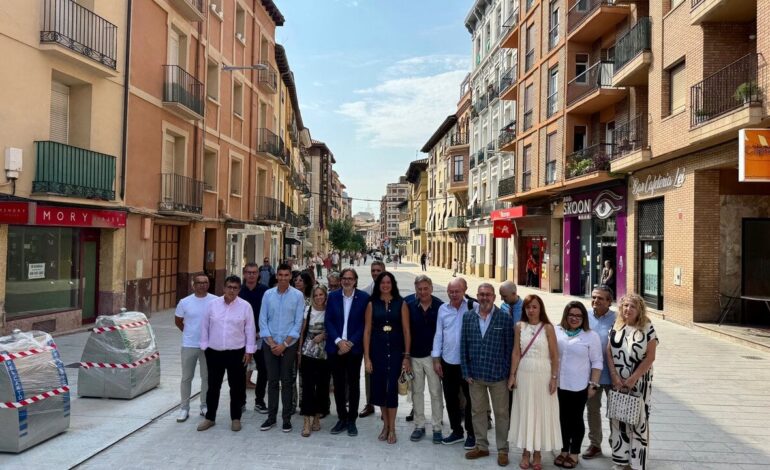

The center of Huesca It is a more accessible, sustainable and designed step for the pedestrian. The City Council has officially inaugurated the renovated high Coso, after completing phase II of its redevelopment, corresponding to the section between the Plaza de la Immaculada and Calle Amilo. The performance has completely transformed this emblematic space, eliminating traditional sidewalks and architectural barriers to create a unique pavement platform that favors pedestrian mobility.
The total investment amounts to 1,473,991.86 euros, of which 390,000 Huesca.
Totally renewed
The works, initiated in November and executed within nine months, have allowed to completely renew the sanitation, drinking water, public lighting and low voltage, also incorporating channeling for telecommunications, irrigation system for the new woodland, two islands of underground containers, renewed urban furniture (benches, stoneware, chairs and a source) and the plantation of 18 trees integrated in the new trees integrated into the new trees in the new layout
One of the outstanding aspects of the project is the organization of furniture in a “functional band”, which allows the celebration of events such as processions, horseback riding or sports events without interference. In addition, it has sought to enhance the architectural value of emblematic buildings such as the Olimpia Theater, the Santa Ana school or the headquarters of Ibercaja, through an intervention that enhances the facades and the environment.
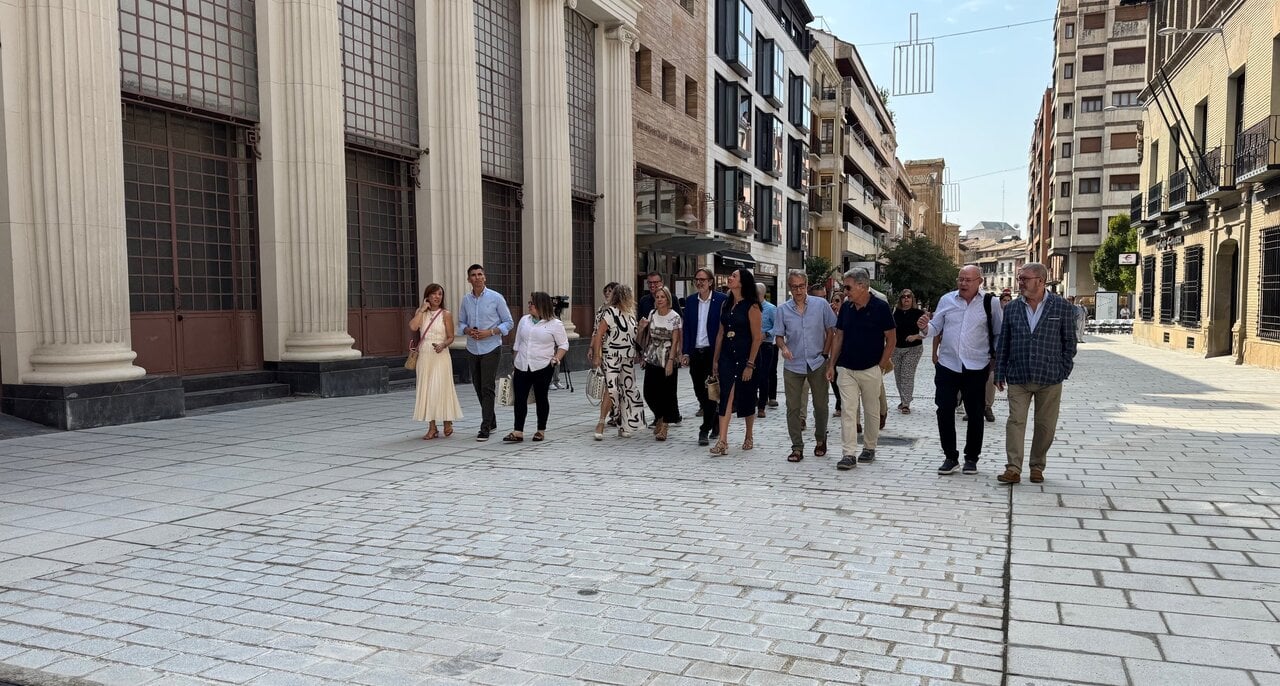
The performance has completely transformed this emblematic space
The mayor of Huesca, Lorena Orduna, has presided over the act with the architect director of the work, Joaquín Sánchez Climent, and institutional representatives, municipal technicians, responsible for the executing UTE (Domec sl + Viax Constructora Aragonese SLU), as well as collectives of trade and hospitality, Olimpia and Ibercaja Theater. “When we started the first phase of pedestrianization of the Coso in mandate 11-15,” said the mayor of Huesca in her speech, “many wondered how life would change in the center; the answer we have seen over time: more people walking, more security, more living streets, more accessible shops and a more attractive environment for neighbors and visitors.”
The current government team, said Orduna, “assumed from the beginning that the project had to be completed and today, thanks to everyone’s commitment, we closed the circle with a section that beautifies and gives new prominence to the Immaculate Square.”
Archaeological finding
During the work, there was also a relevant archaeological finding: “A Roman tombstone appeared currently located in the Huesca Museum, which reminds us that under our feet is the memory of centuries, and that the story of Huesca always accompanies us, even when we build her future,” recalled the mayor. The architect director of the work, Joaquín Sánchez Climent, has indicated that “there was an archaeologist throughout the execution of the works that supervised land movements, carried control and had everything documented.”
The mayor of Huesca has ended her intervention of the opening ceremony indicating that this performance in the Coso “is part of a broader strategy: the implementation of the area of low emissions and a sustainable mobility model that will reduce traffic in the center, but without labels and that will encourage Huesca to be an even healthier and calm and quiet city.”