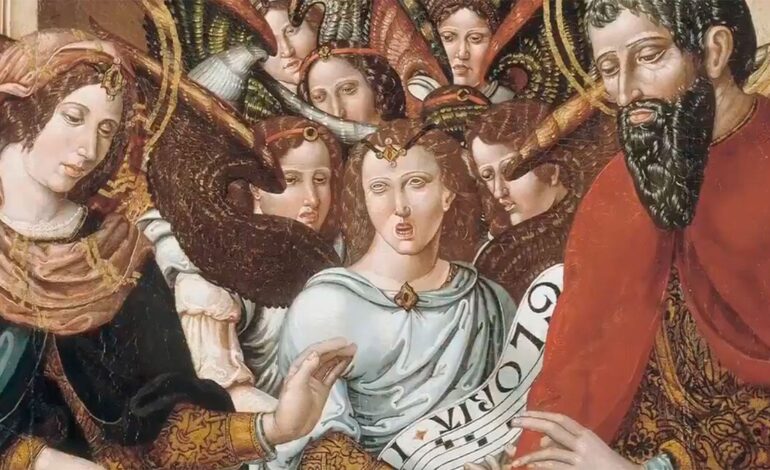

The government of Aragon This Wednesday has dated the departure of the Renaissance table of the monastery of Sijena as prior to the civil war and even 1923, the moment of the dialing of the Cenobio as a national monument, which would prevent claiming said piece as it did happen with the assets of the Diocesan Museum of Lérida and the paintings of the Chapter Room of the MNAC. ‘The Nativity’, which was part of the main altarpiece, has been exhibited in the Prado Museum since 2003, when the State acquired it after having passed through several owners.
According to sources from the Ministry of Culture, the documentation on the wall paintings, contributed by the MNAC within the operation for the transfer to Sijena in seven months, verifies for the moment the exit prior to 1923 and not in 1936, as the historian Juan José Nieto assured Tuesday. It is the date, coinciding with a fire at the beginning of the conflict, which marks the departure of the cenobium of the first fragments of the Chapter Chamber, a judicial front where the Supreme Court has ended up giving the reason to Aragon.
The publication ‘The paintings of Sijena’s main altarpiece. A Renaissance project for a female monastery ’, edited by the regional government, collects a reproduction of said space with the table, they point out. Soon he went to the international art market and there is evidence that in 1926 he appears in a auction house in London, according to the version of the Autonomous Executive.
Without specifying a specific date, they continue, “it seems clear that the images to which reference is being made” by grandson “are not from the year 1936”, since the table “would have been affected by the fire recorded in this place.” “In any case, as with the rest of cultural goods, the Government of Aragon will continue working to recover the cultural heritage that came out irregularly from the community, always hand in hand with its legitimate owners,” they emphasize.
The statement concludes with the commitment to “comply with the judgment of the Supreme Court and the Order of the Court of Huesca which determines the return of the wall and profane paintings to their place of origin, working on the seven -month schedule proposed by the regional executive and that the judge has accepted, giving the MNAC the opportunity to present an alternative. ”
This Wednesday morning, spokesman vice president, Cowboy sea, he has confirmed that the situation of the piece was being studied. “We would act in the same way that we have done with each and every one of the goods that we consider to have to be in Aragon, but I think we still have to wait,” he said.
A work of the year 1500
According to the technical record of the Prado Museum, its current location, ‘La Nativity’ was painted and exposed between 1514 and 1519, about 200 years before the start of the “decomposition” of the altarpiece. Its author is Rodrigo de Saxony, also called “Sijena Master.” The piece shows the Holy Family, with the child at the bottom, the Virgin on the side and San José in the other.